


Views: 0 Author: Site Editor Publish Time: 2026-09-03 Origin: Site


Municipal water infrastructure faces a massive physical challenge. We must upgrade aging pipelines and pump stations within strictly confined spatial footprints. These upgrades demand strict adherence to safety and cross-connection standards. Traditional swing check valves present severe limitations in large-diameter networks. They require a massive installation footprint that complicates retrofits. They also suffer from severe water hammer and surge pressure. Maintenance overhead in confined underground valve vaults remains consistently high.
The butterfly check valve offers a highly engineered alternative. It provides reliable, automatic backflow prevention against backpressure and back-siphonage. This design drastically reduces face-to-face dimensions while mitigating transient surge pressures. Engineers increasingly rely on these compact units to modernize pump stations and ensure safe, uninterrupted water distribution.
Spatial Efficiency: Butterfly check valves offer a significantly reduced face-to-face footprint compared to traditional swing check valves, making them ideal for retrofitting confined municipal pump stations.
Surge Mitigation: The spring-loaded, low-inertia disc design of a butterfly check valve closes rapidly upon flow reversal, effectively minimizing water hammer in high-capacity distribution lines.
Application Limits: While highly efficient for treated water, butterfly check valves require careful evaluation of flow velocities to prevent disc chattering and may not be suitable for raw water containing heavy debris.
Compliance Distinction: A butterfly check valve provides essential one-way flow control as a self-acting safety mechanism, but must be evaluated against local municipal codes and NFPA standards to determine if a dedicated, testable backflow preventer assembly is legally required for cross-connection control.
Understanding the mechanical operation of these valves dictates proper pipeline design. You typically choose between single-disc and dual-plate configurations based on the specific hydraulic requirements of the facility. A single-plate design features one circular disc hinged off-center. Fluid pushes the disc open, and flow reversal forces it closed. However, the dual-plate, or split-disc, configuration dominates municipal applications. This design splits the disc into two semi-circular plates hinged on a central vertical pin.
Torsion springs sit along this central hinge pin. These springs actively push the plates toward the closed position. The spring-assisted closure operates independently of gravity. This allows for versatile installation orientations, including vertical upward flow where traditional valves fail. The dual-plate mechanism divides the mass of the closure element. Lighter plates travel a shorter distance to close. This rapid response protects modern pipelines from reverse flow damage.
Field mechanics appreciate the simplicity of the internal components. The central pin utilizes thrust washers to reduce friction as the plates pivot. Independent spring legs ensure that even if one spring loses tension over decades of use, the other continues to provide closing force. Stop pins prevent the plates from over-traveling and hitting the downstream pipe wall, ensuring the plates remain at the optimal angle for rapid closure.
Standard butterfly valves require external actuation. Operators use handwheels, pneumatic actuators, or electric motors to regulate flow. In contrast, the dual-plate design is a fail-safe device. It requires no external power source. It needs no manual intervention to operate. The valve relies entirely on internal fluid pressure and mechanical springs, making it highly reliable during widespread power outages.
When upstream pressure exceeds downstream pressure, the fluid forces the plates open. The plates fold inward, allowing water to pass with minimal obstruction. As forward flow decreases, the torsion springs begin to close the plates. The valve seals shut before the flow can fully reverse. This automatic operation provides continuous, reliable protection without relying on electronic sensors, PLCs, or human oversight.
These valves function continuously in the background of a water distribution network. Their primary role is to prevent reverse flow. A reliable backflow prevention valve protects the potable water supply against contamination. It addresses two distinct hydraulic threats:
Backpressure: This occurs when downstream pressure exceeds the supply pressure. This often happens due to booster pumps operating in elevated pressure zones or thermal expansion in closed systems. The check valve holds the line, preventing high-pressure water from forcing its way back into the main supply.
Back-siphonage: This involves negative pressure in the supply line. Main breaks, heavy drafting by fire engines, or sudden pump failures cause this vacuum effect. The check valve reacts instantly to this pressure drop. It seals the pipeline, ensuring non-potable or stagnant water cannot siphon backward into the clean distribution grid.
Municipal retrofits face harsh engineering realities. Many underground pump stations and valve vaults were built decades ago. These concrete structures offer very little excess room. Expanding an underground concrete vault is logistically difficult. It requires excavation, traffic diversion, shoring, and significant structural engineering. Traditional valves demand extensive face-to-face clearance, making them nearly impossible to retrofit without major civil works.
Installing a bulky valve in a confined space creates hazardous working conditions. Maintenance crews struggle to access flanges and bolts, often violating OSHA confined space entry protocols. The financial and logistical costs of expanding these vaults often exceed the budget of the pipeline upgrade itself. You must find components that fit within the existing structural footprint. The physical size of the valve dictates the feasibility of the entire retrofit project.
Consider a standard 24-inch pipeline upgrade. A traditional swing check valve might require over 36 inches of face-to-face clearance and weigh upwards of 2,000 pounds. Maneuvering this block of cast iron into a subterranean vault requires removing the vault roof and bringing in a heavy-duty crane. A dual-plate wafer valve of the same diameter requires less than 10 inches of clearance and weighs a fraction of the traditional unit, allowing crews to lower it through standard access hatches.
Water hammer is a destructive force in large-diameter pipes. It occurs when moving water stops abruptly. The kinetic energy of the fluid converts into a high-pressure shockwave. This transient surge pressure travels back and forth through the pipeline at the speed of sound in water. It damages pumps, ruptures pipe joints, and degrades internal cement linings.
A modern water distribution check valve must address this physical threat. The success criteria are straightforward. The valve must close faster than the reverse flow wave can propagate. Traditional valves often close too late. The reverse flow catches the closing disc and slams it into the seat. This mechanical slam amplifies the water hammer effect.
A spring-assisted design closes the plates a fraction of a second before reverse flow begins. This proactive closure protects the entire distribution network from catastrophic pressure spikes. By minimizing the reverse velocity before closure, the dual-plate design effectively neutralizes the primary trigger for check valve slam.
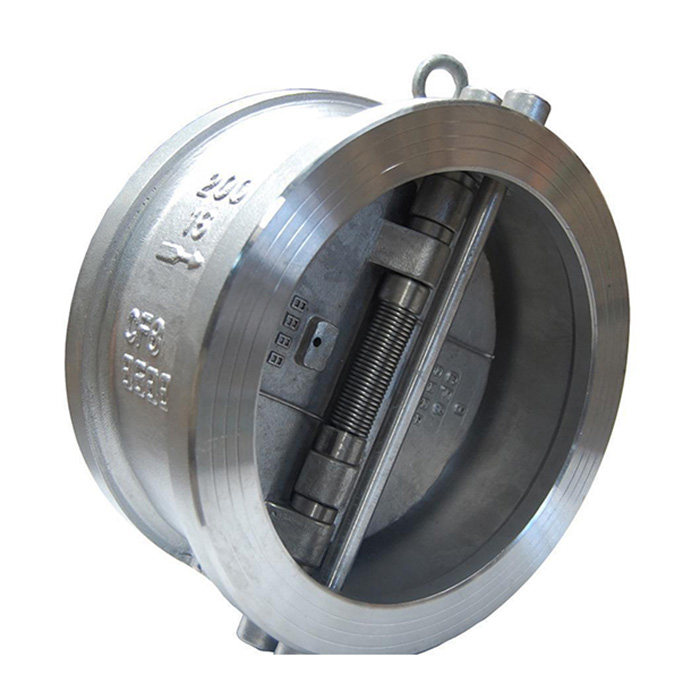
Engineers frequently compare these two dominant designs. The traditional swing check valve features a single, heavy disc hinged at the top. It relies heavily on gravity and reverse flow to push the disc closed. This design requires a massive cast body. The face-to-face dimensions are substantial. The heavy disc travels a long arc to reach the seat, increasing the risk of mechanical slam.
The dual-plate design offers a stark contrast. The face-to-face dimension is drastically shorter. The weight of the unit is significantly lower. This impacts shipping, handling, and installation logistics. Furthermore, the installation orientation is highly flexible. Swing check valves struggle in vertical upward flow applications because gravity works against the hinge mechanism. The spring-loaded dual-plate design excels in these vertical orientations.
Feature | Traditional Swing Check Valve | Dual-Plate Butterfly Check Valve |
|---|---|---|
Face-to-Face Dimension | Large and bulky, requiring extensive pipe clearance. | Highly compact, fitting easily between standard flanges. |
Weight | Heavy cast body requires robust pipe supports and thrust blocks. | Lightweight flangeless design reduces structural load on the pipe. |
Closure Speed | Slow, relies on gravity and reverse flow to push the disc. | Fast, spring-assisted closure prevents mechanical slam. |
Water Hammer Risk | High potential for mechanical slam and surge pressure generation. | Low risk due to low-inertia plates and proactive spring closure. |
Vertical Installation | Poor performance; gravity impedes proper closure and sealing. | Excellent performance; springs operate independently of gravity. |
The industry maintains a strict distinction regarding cross-connection control. A standard check valve provides basic, mechanical backflow prevention. However, municipal health codes and fire protection standards demand more for high-hazard situations. The National Fire Protection Association (NFPA) and local water authorities strictly regulate cross-connections to protect public health.
High-hazard applications require dedicated, testable assemblies. Reduced Pressure Zone (RPZ) assemblies and Double Check Valve Assemblies are legally mandated in these scenarios. These certified assemblies utilize two independently acting, spring-loaded check valves. They include test cocks and isolation valves for annual certification by licensed technicians.
A single compact valve is sufficient for pump discharge protection and general zone isolation within the grid. It is not a legal substitute for a certified RPZ assembly at a high-hazard commercial service connection, such as a chemical plant or hospital. You must define exactly where basic mechanical prevention is sufficient versus where a certified assembly is mandated by local plumbing codes.
The installation mechanics of a wafer-style body provide immediate advantages in the field. This design is flangeless. It clamps directly between the existing pipeline flanges. Long threaded studs pass around the valve body, securing the two pipe flanges together. This configuration defines the compact check valve advantage.
The reduced pipeline weight is substantial. Heavy cast flanges are eliminated from the valve body itself. This weight reduction eliminates the need for heavy, custom-built pipe supports beneath the valve. Installation in tight quarters becomes significantly safer and faster. Maintenance crews can maneuver the lighter valve into position without requiring heavy overhead cranes. The clamp-in design simplifies alignment and reduces the physical strain on installation teams.
When installing these units, crews must pay close attention to gasket selection. Because the valve body sits inside the bolt circle, ring gaskets are typically preferred over full-face gaskets. Proper torque sequencing on the flange studs ensures an even seal and prevents the valve body from binding the internal plates.
Hydraulic efficiency requires a realistic assessment. Every component placed inside a pipeline creates resistance. A fully open, full-port swing check valve offers a relatively clear path for water. The dual-plate design introduces internal components to the flow stream. The central hinge post and the open plates obstruct the flow slightly.
This obstruction creates a marginally higher pressure drop across the valve. You must calculate this acceptable trade-off. The slight increase in head loss forces pumps to work marginally harder to maintain system pressure. However, the hydrodynamic profile of modern plates minimizes this resistance. The energy required to overcome this slight head loss is often offset by the protection against catastrophic surge pressures.
Accurate flow coefficient (Cv) calculations ensure the selected valve aligns with the pump's performance curve. If the pressure drop is too high, it can lead to cavitation downstream of the valve, which damages the pipe lining and the valve seats. Sizing the valve correctly based on flow rate rather than just matching the pipe diameter mitigates this risk.
The integrity of the seal depends entirely on the seating materials. Metal-to-metal seats offer extreme durability and resist abrasive wear. However, they rarely provide a bubble-tight seal. Municipal potable water applications typically require resilient seating options to prevent any backflow seepage.
EPDM (Ethylene Propylene Diene Monomer): Provides excellent resistance to chloramines and other water treatment chemicals. It is the standard choice for municipal drinking water.
Buna-N (Nitrile): Offers robust performance in general water applications and handles trace oils well, though it is less resistant to heavy chlorination than EPDM.
Viton (FKM): Used in specialized applications requiring high chemical resistance, though rarely necessary for standard municipal water.
These resilient seats vulcanize directly to the valve body or attach to the disc edges. They compress upon closure, providing a tight, leak-free seal. You must verify compliance with the American Water Works Association (AWWA). AWWA standards dictate allowable leakage rates for municipal applications. Resilient seated dual-plate valves consistently meet or exceed these stringent potable water requirements.
Operational failures often stem from misapplication rather than mechanical defects. A common issue involves minimum flow velocity. These valves require a specific flow rate to push the plates fully open. The fluid must exert enough hydrodynamic force to overcome the tension of the torsion springs.
If the flow velocity is too low, the plates will not fully open. They will hover in the flow stream. The turbulence of the water will cause the plates to bounce rapidly against the central stop pin. This phenomenon is known as chattering. Chattering causes accelerated spring wear. It damages the hinge mechanism and leads to premature failure.
You must size the valve based on actual flow rates, not just the pipe diameter. Ensuring sufficient velocity keeps the plates stable and extends the operational life of the unit. If a system experiences prolonged periods of low flow, a lighter spring configuration or a smaller valve with pipe reducers might be necessary to maintain plate stability.
The internal geometry of the dual-plate design presents specific vulnerabilities. The central hinge mechanism sits directly in the flow path. This makes the valve highly susceptible to stringy debris, rags, or large solids. Debris can wrap around the hinge pin in a process known as ragging.
This entanglement prevents the plates from closing fully, destroying the backflow prevention capability. Therefore, these valves are optimized for clean, treated water distribution. They perform exceptionally well downstream of filtration plants and in finished water pump stations. They are not suitable for raw wastewater, untreated sewage, or heavily sedimented intake lines. You must specify full-port valves for raw water applications to prevent debris accumulation and ensure reliable operation.
The compact wafer design introduces a specific maintenance trade-off. Traditional top-entry swing valves allow crews to remove a bolted cover. They can inspect the internal disc or replace the seat without removing the valve body from the pipeline. This in-line repair capability is advantageous in certain scenarios where line shutdowns are highly disruptive.
A wafer butterfly check valve typically lacks this top-entry access. To perform an internal inspection, replace worn springs, or change a damaged elastomer seat, the crew must remove the entire valve from the pipeline. The pipeline must be isolated, drained, and the flange studs removed. While the lightweight nature of the valve makes removal easier, it still requires a complete line shutdown. Maintenance schedules must account for this requirement during system planning, often utilizing bypass lines to maintain service during valve inspections.
Evaluating the true value of pipeline components requires looking beyond the physical unit. The installation phase reveals significant labor and resource savings. The compact nature of the wafer design drastically reduces the required vault size. Pouring less concrete, excavating smaller footprints, and requiring less shoring accelerates project timelines.
Furthermore, the reduced weight lowers shipping and freight logistics. On-site, crews spend fewer hours maneuvering the unit into place. The elimination of custom pipe supports and complex flange alignments streamlines the mechanical assembly. These physical resource savings make the dual-plate design highly attractive for large-scale municipal retrofits where civil engineering costs often dwarf mechanical equipment costs.
System efficiency over a 20-to-30-year lifecycle depends heavily on hydraulic performance. Pumps consume vast amounts of electricity pushing water through distribution grids. Every point of resistance in the pipeline forces the pump to draw more power.
While the central hinge pin creates a slight pressure drop, careful sizing mitigates this issue. Selecting a valve with an optimized hydrodynamic profile ensures the head loss remains within acceptable parameters. The continuous energy required to overcome this resistance is a critical operational metric. You balance this slight energy draw against the massive protection the valve provides to the pumps themselves. Preventing a single catastrophic water hammer event justifies the marginal difference in hydraulic resistance.
Continuous municipal duty places immense strain on mechanical components. The durability of the internal parts dictates the replacement cycle. The torsion springs endure thousands of open-and-close cycles. High-grade stainless steel springs resist fatigue and corrosion, ensuring long-term reliability.
The elastomer seats also face continuous exposure to treated water and treatment chemicals. High-quality EPDM resists degradation and maintains its elasticity over time. Establishing realistic expectations for maintenance intervals is vital. While the metal body can last decades, the springs and resilient seats are wear parts. Proactive replacement of these internal components during scheduled plant shutdowns prevents unexpected failures and maintains the integrity of the distribution network.
To ensure optimal performance and compliance in your next municipal pipeline upgrade, follow these immediate steps:
Calculate precise system head loss using the manufacturer's Cv values to ensure the selected valve aligns with your existing pump performance curves.
Verify minimum flow velocities under off-peak conditions to guarantee the plates remain fully open and prevent mechanical chattering.
Inspect existing vault dimensions and flange specifications to confirm the exact face-to-face clearance available for the new installation.
Consult local AWWA standards and municipal health codes to confirm whether a mechanical check valve meets regulatory requirements for your specific cross-connection hazard level.
A: A standard butterfly valve is externally actuated using a handwheel or motor for flow regulation and isolation. A butterfly check valve operates automatically as a self-acting safety mechanism. It relies entirely on fluid pressure and internal springs to open and close, preventing reverse flow without manual intervention.
A: Yes, it prevents backflow mechanically against backpressure and back-siphonage. However, it may not satisfy legal municipal


