


Views: 0 Author: Site Editor Publish Time: 2026-07-01 Origin: Site


In power generation, ambiguity regarding fluid flow state creates critical safety and operational hazards. Plant operators cannot afford to guess whether an isolation point is fully open, partially blocked, or fully closed. A single misjudgment can lead to catastrophic system failures or severe personnel injury. High-pressure steam systems and cooling loops require absolute certainty. You need a reliable mechanical indicator to verify flow status instantly.
This strict requirement makes the rising stem gate valve, specifically the OS&Y design, the industry standard for visual verification. It acts as an unmistakable marker of system readiness. Selecting the right component requires careful engineering balance. You must weigh overhead space constraints against the urgent need for immediate visual feedback. You must also evaluate maintenance accessibility and your specific fluid conditions.
This article explores how these robust mechanisms function under extreme industrial stress. We will examine core engineering trade-offs and common failure modes. You will learn how to specify the exact right valve configuration to guarantee maximum safety and operational resilience in your facility.
Definitive Indication: Rising stem designs provide instant visual confirmation of the valve's position, eliminating guesswork in critical power plant and fire safety systems.
Thread Protection: By placing the stem threads outside the fluid boundary (OS&Y), these valves protect internal mechanisms from corrosive, high-temperature, or debris-laden media.
Strict Isolation, Not Throttling: Gate valves are strictly designed for full on/off isolation; using them for throttling causes severe vibration and uneven wear.
The Core Trade-Off: The primary cost of a rising stem design is the required vertical installation clearance; selecting the wrong valve type leads to inoperability or premature mechanical failure.
Understanding valve operation begins by breaking down the Outside Screw and Yoke (OS&Y) design. This architecture separates the actuation mechanism from the fluid pathway. The handwheel attaches to a stationary nut. This nut sits securely atop the external yoke assembly. As operators rotate the handwheel, the nut turns in place. It engages the threaded stem running through its center. Because the nut cannot move vertically, the rotational force drives the threaded stem in a linear up-and-down motion. The gate, attached directly to the bottom of the stem, lifts vertically out of the fluid stream.
We can break this mechanical sequence into three distinct actions:
Rotational Input: The operator applies torque to the handwheel.
Linear Translation: The stationary yoke nut converts this rotation into vertical movement along the stem.
Flow Clearance: The gate elevates fully into the upper bonnet chamber, leaving a completely unobstructed fluid path.
This contrasts sharply against Non-Rising Stem (NRS) valves. NRS configurations keep the threads submerged directly inside the process fluid. The stem itself does not elevate through the handwheel. Instead, the gate climbs the hidden threads like a nut traveling along a bolt. Operators cannot look at an NRS valve and instantly know its position.
For high-pressure applications, engineers rely on a specialized variant. A wedge rising stem gate valve uses a distinctly tapered, wedge-shaped disk. When driven downward into the closed position, this wedge forces itself between two angled seats within the valve body. The mechanical wedging action creates an incredibly tight, high-pressure seal. Power facilities require this exact mechanism for safely isolating volatile steam lines and boiler feedwater networks.
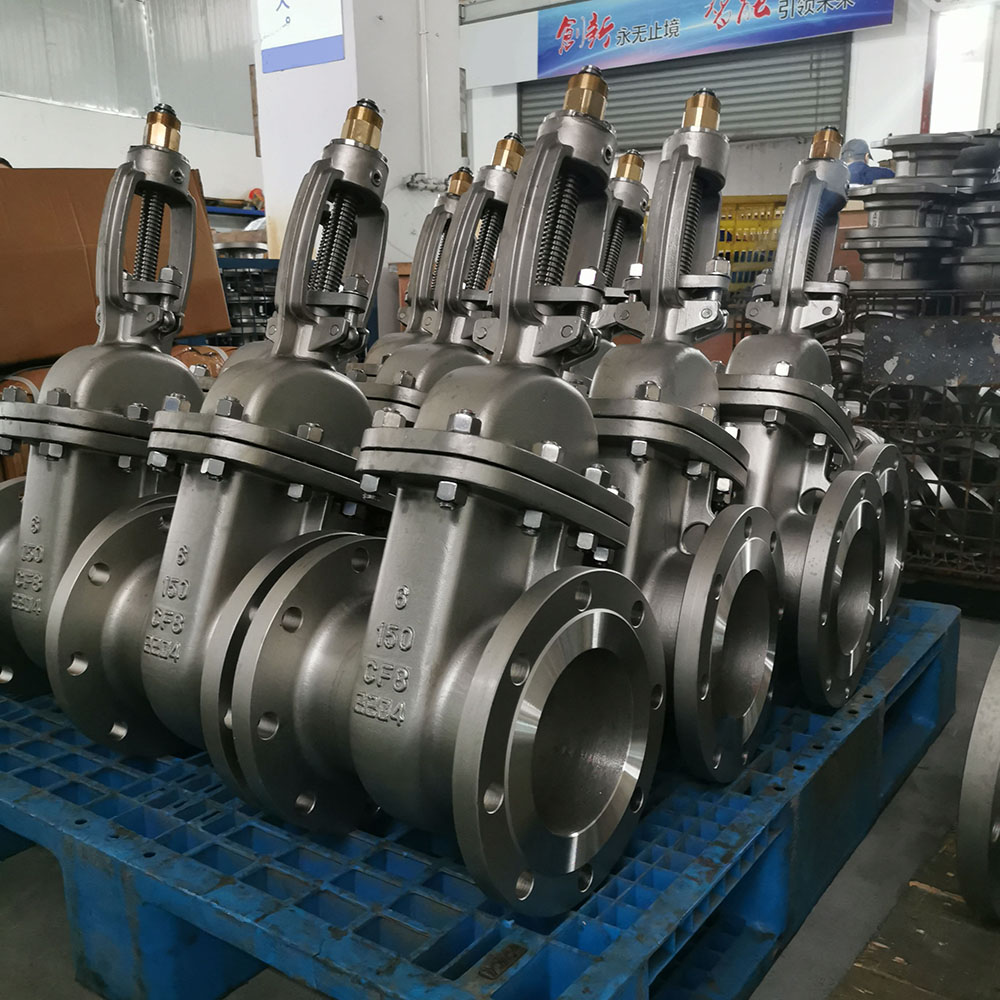
Power plants operate under unforgiving conditions. High-pressure boiler systems, cooling towers, and plant fire protection loops demand intense regulatory compliance. Operational protocols legally mandate visual confirmation of valve status across these critical networks. Operators managing a power generation gate valve must verify isolation boundaries before authorizing maintenance. A mistaken assumption about fluid state can release deadly steam or drain vital fire-suppression water.
Rapid troubleshooting relies heavily on clear visual cues. Plant technicians conduct frequent walkdowns through vast piping networks. They need to assess system health quickly. Rising stems make this process highly efficient. A technician looking down a long pipeline can instantly identify isolated lines from a distance. If the stem extends high above the handwheel, the line flows freely. If the stem sits flush, the line remains closed. Technicians do not need to apply physical torque checks to verify position. This saves thousands of man-hours annually and prevents accidental manipulation of active valves.
Environmental resilience adds another layer of operational security. Power plants handle abrasive internal media. Boiler feed water carries chemical impurities. Ash handling systems move thick slurry. Submerged threads degrade rapidly under these conditions. However, OS&Y designs keep the critical drive threads completely isolated from the internal fluid. They operate in the ambient plant atmosphere. When technicians maintain proper external lubrication, these threads easily withstand plant conditions. The mechanism remains safe from internal scouring and chemical attack.
Feature Requirement | Rising Stem (OS&Y) | Non-Rising Stem (NRS) |
|---|---|---|
Visual Position Verification | Instant and absolute | Impossible without physical test |
Thread Protection (Internal) | Completely isolated from fluid | Submerged in process fluid |
Walkdown Efficiency | High (visual check from distance) | Low (requires manual torque check) |
Every mechanical advantage carries an engineering cost. For rising stem designs, space requirement serves as the most significant limiting factor. The physical footprint extends far beyond the valve body itself. Engineers must account for the fully extended stem above the piping center line. In a 24-inch pipeline, the open stem might require several additional feet of vertical clearance. You cannot install these components in cramped pipe racks or low-ceiling utility tunnels without risking physical obstruction.
External exposure introduces specific maintenance vulnerabilities. While the external threads remain safe from harsh internal fluids, they face the ambient plant environment. Atmospheric dust, coal ash, and chemical vapors settle onto the exposed grease. In coastal power plants, corrosive sea-salt poses a severe threat to bare metal. Facility managers must implement a strict preventative lubrication schedule. Neglecting this routine allows airborne particulates to form an abrasive paste on the stem threads. Over time, this grinds down the metal and causes actuation stiffness.
Actuation torque profiles highlight a major benefit when maintained correctly. Submerged threads in NRS designs often suffer from debris buildup. Sludge or scale packs into the internal thread pitch. This causes erratic torque requirements. Operators might need mechanical persuaders to force the valve closed. Conversely, OS&Y threads sit externally. Maintenance crews can easily clean and regrease them during normal operations. Because the threads remain accessible, the valve generally maintains a smoother, highly predictable torque profile across its entire operational lifecycle.
If installing OS&Y valves in highly dusty environments (like coal handling facilities), equip the exposed stem with a flexible bellows cover or protective sleeve. This simple addition prevents ash accumulation on the greased threads while preserving visual indication capabilities.
Selecting the wrong isolation mechanism initiates a countdown to system failure. Engineers must match the component architecture directly to the fluid and spatial realities of the installation environment. Failing to do so triggers specific, highly destructive mechanical scenarios.
Scenario 1: Misapplying NRS in Dirty Fluids
Using an internal-thread valve in thick fluids creates immediate problems. Sludge, slurry, and particulate-heavy water infiltrate the hidden thread mechanism. As operators cycle the valve, debris compacts inside the internal nut. Thread jamming occurs rapidly. The required operating torque skyrockets beyond manual limits. Operators force the handwheel, eventually stripping the threads or snapping the stem entirely. The valve fails permanently in place, demanding an emergency pipeline shutdown for replacement.
Scenario 2: Specifying Rising Stem in Confined Spaces
Installing an OS&Y valve in a cramped underground vault invites operational disaster. Piping schematics often look fine on a two-dimensional screen. However, physical installation reveals severe headroom deficits. As the operator opens the valve, the rising stem strikes the vault ceiling or overhead structural beams. The valve cannot fully open. It remains stuck in a partially open position. This functionally throttles the system, restricting flow volumes and creating immediate operational bottlenecks across the plant network.
Scenario 3: Using Gate Valves for Flow Control
We must continually reiterate the extreme danger of throttling. Gate valves perform strict on/off isolation. Exposing a partially open wedge to high-velocity power plant steam triggers aggressive fluid dynamics. The steam cuts across the exposed lower edge of the wedge. This causes severe flow-induced vibration. The disk chatters violently against the seats. Rapid erosion destroys the precisely machined sealing surfaces. When operators finally attempt to close the valve fully, the damaged wedge cannot form a seal. Catastrophic leak-by occurs.
Never instruct operators to "crack open" a gate valve to manage system pressure. If a pipeline requires continuous flow regulation or pressure reduction, you must specify a globe valve or a control valve engineered specifically for throttling dynamics.
Procurement and design engineers need clear parameters for component selection. Fluid properties, spatial availability, and safety regulations dictate the correct path. Use the following decision matrix to eliminate guesswork during the design phase.
Unrestricted Vertical Clearance: Above-ground installations, open-air pipe racks, and multi-level grated platforms where vertical overhead space poses no issue.
Critical Safety Loops: Fire water mains, emergency shutdown systems, and boiler feed lines that legally require instant visual audits during walkdowns.
Harsh Media Applications: Systems handling abrasive slurry, high-temperature steam, or high-viscosity fluids that would quickly destroy submerged internal threads.
Directly Buried Pipelines: Underground networks covered entirely by soil where visual indication remains physically impossible.
Strict Clearance Limits: Extremely compact equipment skids, low-ceiling subterranean utility vaults, or dense piping manifolds where a rising stem would collide with infrastructure.
Clean Process Fluids: Filtered utility water or treated cooling systems where internal thread corrosion and particulate jamming present very low operational risks.
Application Environment | Primary Valve Recommendation | Key Rationale |
|---|---|---|
Power Plant Fire Main | Rising Stem (OS&Y) | Mandatory visual inspection requirements |
Buried Municipal Water Line | Non-Rising Stem (NRS) | Zero overhead clearance; visual checks impossible |
Ash Slurry Transport Line | Rising Stem (OS&Y) | Abrasive media destroys submerged threads |
High-Pressure Steam Isolation | Rising Stem (OS&Y) | Wedge seal required; visual safety verification critical |
Effective flow control in power generation hinges on absolute certainty. While NRS configurations successfully save space in cramped or buried environments, the OS&Y design stands apart in critical operations. A rising stem gate valve remains the uncompromising choice for heavy industrial applications where visual certainty is non-negotiable. It isolates delicate actuation threads from brutal process fluids, ensuring predictable performance during emergency shut-offs.
Moving forward, procurement engineers must actively audit their physical installation environments before finalizing piping schematics. Map out your vertical clearances meticulously. Analyze your fluid particulate levels and ambient environmental conditions. Implement a strict maintenance schedule for exposed components. By aligning your valve selection with these physical realities, you guarantee robust isolation, enhance daily operational safety, and eliminate the costly hazards of system ambiguity.
A: It stands for Outside Screw and Yoke. It is the technical designation for a rising stem configuration where the threaded mechanism and stationary nut sit external to the valve body. This design keeps the threads isolated from the internal process fluid.
A: No. Gate valves are exclusively designed for full-open or full-closed isolation. Using them to throttle flow causes severe high-velocity fluid wear to the disk and seating surfaces, leading to rapid vibration and permanent seal failure.
A: Generally, yes, especially in harsh media. Because the actuating threads do not come into direct contact with the process fluid, they remain protected from internal chemical corrosion and particulate abrasion. They require consistent external lubrication to maintain this longevity.


