


Views: 0 Author: Site Editor Publish Time: 2026-05-26 Origin: Site


In petrochemical fluid handling, an incorrect diversion valve choice doesn't just cause inefficiencies. It leads to hazardous cross-contamination, unexpected pressure drops, and severe compliance failures. Getting this component right secures your entire process loop and protects facility personnel.
Deciding between an L-Port and T-Port configuration requires more than checking pipeline geometry. You must deeply understand media behavior, fail-safe alignment, and strict fugitive emission standards. Volatile compounds demand absolute control. Proper specification becomes critical for overall plant safety.
This guide breaks down technical flow paths, application-specific criteria, and hidden implementation risks. We aim to help engineering and procurement teams specify the exact right component confidently. You will learn how to evaluate bore designs, mitigate dead-leg hazards, and meet strict industry standards. By understanding these core dynamics, you can prevent dangerous misapplications. Read on to master flow path logic and secure your next processing project phase.
L-Port (Diverting): Exclusively directs flow from one common port to one of two distinct paths (90-degree turn). Ideal for tank switching or line isolation.
T-Port (Mixing/Dividing): Offers versatile flow paths including straight-through, dividing one stream into two, or blending two streams into one.
Connection Standards: A flanged three-way ball valve is the industry baseline for high-pressure, hazardous petrochemical applications, ensuring leak-tight reliability over threaded alternatives.
Decision Driver: Final selection must heavily weight dead-leg risks, automation (actuation) requirements, and system pressure ratings alongside basic flow patterns.
Engineers must establish foundational clarity on flow geometry. Doing so prevents costly and dangerous mis-specifications. A standard two-way valve simply starts or stops fluid. Multi-port valves manage complex routing networks. You must understand internal bore shapes to control fluid direction accurately. Specifying a three-way ball valve correctly relies entirely on matching the ball's internal channel to your system goals.
The L-Port design features a 90-degree internal channel bored into the ball. We often call it a diverting valve. Fluid enters a common bottom or side port. The ball then forces the fluid to make a hard 90-degree turn. It exits through one designated side port.
You shift the flow path by rotating the valve handle or actuator 90 degrees. This rotation connects the common port to the alternate side port. It physically blocks the previous path. Because of this L-shaped geometry, an L-port cannot have an "all ports open" configuration. The ball material always blocks at least one port.
This limitation serves as an excellent safety feature. It creates a standard fail-safe positioning system. By rotating the ball exactly 180 degrees from its starting point, you can shut off flow entirely. The solid side of the ball faces the common inlet. This stops media movement completely.
T-Port designs feature a T-shaped internal channel. This channel intersects completely through the ball. The straight-through design provides significantly more routing flexibility.
You can achieve multiple distinct flow patterns using a T-Port design:
Straight-Through: Fluid travels in a straight line (180 degrees) from one port to the opposite port, bypassing the third branch completely.
Splitting (Dividing): Fluid enters the common port and splits into two separate streams. It exits through both opposite side ports simultaneously.
Blending (Mixing): Two distinct fluids enter through the side ports. They merge inside the ball chamber. The blended media exits through the common center port.
T-Port mechanics present specific limitations. They easily achieve an "all ports open" configuration. However, achieving an "all ports closed" state is mechanically difficult. Standard 90-degree actuator rotations cannot block all three ports simultaneously. If your system requires absolute shut-off, you must install additional isolation valves upstream. You might also specify a customized ball drilling pattern, though this complicates automation.
Connecting mechanical functions to real-world engineering outcomes drives successful facility design. Petrochemical plants handle highly volatile, corrosive, and temperature-sensitive media. You must map the valve's internal geometry directly to the process requirement.
L-Port configurations excel in isolation and diversion tasks. Facility operators rely on them when cross-contamination presents severe safety risks.
Tank and Pump Switching: Many petrochemical systems utilize redundant feed lines. If a primary pump fails, operators must switch to a backup pump instantly. They cannot shut down the primary system to make the switch. An L-Port valve transitions flow from Pump A to Pump B seamlessly. The 90-degree bore ensures fluid never flows back into the offline pump.
By-pass Routing: Equipment maintenance requires safe isolation. Operators frequently use L-Ports to divert hazardous media away from inline filters, heat exchangers, or sensor arrays. While maintenance teams replace a filter cartridge, the fluid bypasses the housing. This keeps the larger process loop running safely.
T-Port configurations solve complex distribution challenges. They manage continuous flow dynamics where streams must interact.
Media Blending: Chemical synthesis often requires precise mixing of precursors. A T-Port valve accepts two separate feed lines. For example, you might blend a hydrocarbon base with a catalyst. The fluids merge inside the valve body. They exit as a single unified stream into a reactor vessel.
Simultaneous Distribution: Sometimes a single bulk feed must supply multiple process units. A T-Port divides one primary stream into two parallel lines. You might feed a single cooling water supply into two separate heat exchange towers simultaneously.
Feature / Requirement | L-Port Application | T-Port Application |
|---|---|---|
Primary Function | Divert, Switch, Isolate | Mix, Blend, Divide, Straight-Through |
Simultaneous Flow | Never (One path at a time) | Yes (Can split or mix streams) |
Complete Shut-Off | Achievable via 180° rotation | Generally not possible natively |
Common Petrochemical Use | Duplex strainer switching | Reactor precursor blending |
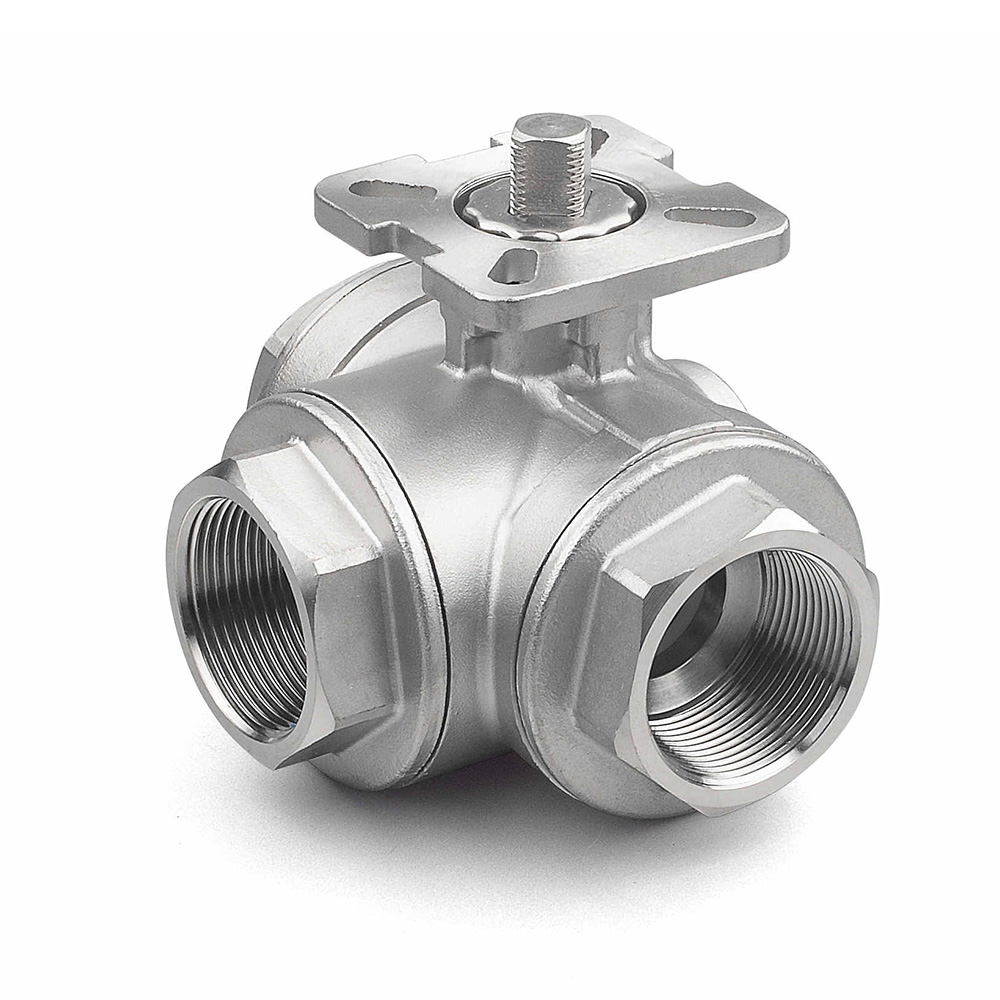
Selecting the right hardware demands strict evaluation lenses. You must translate physical features into safe process outcomes. A confident purchasing decision relies on rigorous mechanical standards.
High-pressure environments tolerate zero leakage. Threaded ends (NPT) often suffice for basic utility water. However, petrochemical plants process volatile organic compounds (VOCs). These gases exploit microscopic gaps in threaded joints. This causes fugitive emissions, posing massive safety and environmental risks.
To combat this, you must specify a flanged three-way ball valve. Flanges distribute mechanical stress evenly across a broad surface area. They utilize engineered gaskets to create an impenetrable seal. Adhering to ASME B16.5 standards is strictly non-negotiable. Flanged connections handle the extreme vibrational stress of heavy pipe runs. They also simplify maintenance drop-outs during facility turnarounds.
Abrasive and corrosive media destroy inadequate seals rapidly. You must match seat materials directly to the fluid's chemical profile.
PTFE (Teflon) seats provide excellent chemical resistance. They work perfectly for general solvent distribution at moderate temperatures. However, high-temperature catalytic processes easily melt standard PTFE. For aggressive environments, specify PEEK seats. PEEK handles much higher thermal loads while maintaining structural rigidity.
If your process involves heavy particulates or abrasive slurries, soft seals will fail. You must upgrade to metal-seated designs. Metal-to-metal sealing surfaces undergo specialized hardening processes. They scrape the ball clean during rotation, preventing particulate embedding.
Fluid moving through multi-port intersections experiences turbulence. This turbulence creates an inherent pressure drop. Engineers measure flow capacity using the Cv value. The Cv value indicates the volume of water (in gallons per minute) flowing through the valve at a one psi pressure drop.
You must size your valve appropriately. A multi-port design naturally has a lower Cv than an equivalent two-way straight valve. If you undersize the bore, fluid velocity spikes. Rapid pressure drops cause the liquid to vaporize and implode. We call this cavitation. Cavitation destroys internal valve components rapidly. Always calculate system pressure drops meticulously before finalizing bore dimensions.
Even perfectly specified components can fail during implementation. You must anticipate operational hazards post-installation. Recognizing these blind spots prevents catastrophic system failures.
Installing a highly engineered petrochemical diversion valve requires precise execution. Field errors introduce severe vulnerabilities into the process loop.
"Dead Leg" Hazards: Fluid frequently becomes trapped inside closed-off ports. Engineers call this stagnant zone a dead leg. In petrochemical processes, trapped media crystallizes, polymerizes, or becomes highly corrosive over time. When operators finally cycle the valve, this degraded material flushes into the main line. This causes massive batch contamination. Always position valves to drain stagnant legs by gravity. Flush ports regularly.
Actuation & Automation Errors: Multi-port valves require precise pneumatic or electric actuation. Technicians sometimes misalign the actuator limit switches with the valve stem. This error leads to partial port openings. Instead of cleanly switching lines, the ball hovers halfway. Unintended mixing occurs immediately. Always calibrate positioners perfectly during commissioning. Use direct-mount ISO 5211 actuator pads to minimize mechanical slop.
Torque Requirements: Multi-port designs feature up to four separate seats pressing against the ball simultaneously. This massive friction surface drastically increases breakaway torque. Operators routinely under-size actuators because they base calculations on standard two-way valve data. An under-sized actuator stalls during mid-cycle. Always apply a generous safety factor to torque requirements when sizing automation packages.
Streamlining the specification process reduces engineering delays. We use a concise logic framework to drive immediate action. Follow these sequential steps to shortlist the correct configuration accurately.
Step | Decision Focus | Engineering Action |
|---|---|---|
Step 1 | Determine Primary Function | If strictly diverting flow, select L-Port. If splitting or mixing streams, select T-Port. |
Step 2 | Assess Shut-Off Needs | Does the system need absolute shut-off? If yes, L-Ports natively support this. T-Ports require upstream isolation valves. |
Step 3 | Define Pipeline Class | Match maximum system pressure to ASME flange classes (e.g., Class 150, Class 300). Ensure body wall thickness complies. |
Step 4 | Actuator Mapping | Verify handle/actuator rotation. L-Ports generally need 90° rotation. Certain T-Port patterns require 180° rotation for full cycles. |
This flow path decision tree simplifies initial engineering reviews. First, lock down the primary function. Once you define the fluid routing geometry, you evaluate the mechanical support systems. You move sequentially from bore geometry to pressure containment, and finally to automation logic. Doing so ensures you address every critical variable systematically.
Specifying the correct three-way ball valve goes far beyond picking between an L-port and a T-port. It requires a highly holistic view of process safety, structural integrity, and fluid dynamics. Petrochemical environments leave absolutely no room for routing errors or fugitive emissions.
Define specific flow paths early: Use L-ports strictly for diversion and T-ports for mixing or splitting.
Prioritize pressure boundaries: Rely exclusively on ASME-compliant flanged connections to mitigate VOC leaks.
Calculate exact torque and Cv values: Size actuators generously and verify flow coefficients to prevent system cavitation.
Anticipate dead legs: Design piping layouts to minimize stagnant fluid zones within the valve body.
Review technical spec sheets meticulously before finalizing your facility designs. Download detailed flow diagram assets to verify actuator rotation logic. Contact an experienced engineering team for a custom application review to guarantee process safety and regulatory compliance.
A: Yes, mechanically. By limiting the actuator rotation strictly to 90 degrees, a T-port can function similarly to an L-port. However, we rarely recommend this setup. It introduces significant dead-leg issues where fluid becomes trapped in the unused branch. It also frequently causes operator confusion during manual overrides.
A: Flanged connections handle the extreme mechanical stress of heavy industrial piping vastly better than threaded joints. They simplify maintenance drop-outs significantly. Most importantly, they utilize engineered gaskets to provide a superior, verifiable seal. This prevents dangerous volatile organic compound (VOC) leaks common in refinery applications.
A: Operators look for specific T- or L-shaped directional indicators. Manufacturers stamp or mill these indicators directly into the top of the valve stem. These markings align perfectly with the internal bore paths. They remain visible and accurate even when you remove the operating handle or actuator.
