


Views: 0 Author: Site Editor Publish Time: 2026-05-19 Origin: Site


In semiconductor fabrication and specialty gas distribution, fluid control stakes are exceptionally high. Microscopic contamination causes catastrophic yield losses. Even a single stray particulate or trace hydrocarbon outgassing event ruins sensitive silicon wafers. Engineers face immense pressure to maintain absolute system purity. You must differentiate standard degreased valves from true cleanroom-certified components. Simply washing industrial parts in commercial solvent never guarantees the pristine environment modern fabs require. Standard cleaning leaves trace residues. These residues inevitably degrade gas purity over time. True purity demands rigorous manufacturing controls at every single stage. This checklist provides a definitive framework for procurement engineers. You will learn how to properly evaluate, shortlist, and specify these critical components. We outline exact material standards, surface treatments, and necessary cleanroom assembly protocols. By following this framework, you can specify reliable valves confidently. You will protect your high-purity gas streams without compromising overall system integrity.
True oil-free status requires verifiable cleanroom assembly and specialized ultrasonic cleaning, not just standard industrial degreasing.
Surface finish (Ra values) and Electropolishing (EP) are non-negotiable metrics for preventing particulate entrapment in a high purity ball valve.
Procurement validation must include Material Test Reports (MTRs), Helium leak test data, and documented fugitive emission compliance (e.g., ISO 15848).
Selecting the right seat material (e.g., virgin PTFE vs. PCTFE) dictates performance under specific pressure and chemical compatibility constraints.
Hydrocarbon residue from standard machining processes presents a hidden, severe danger. Manufacturers use heavy cutting fluids and industrial lubricants to shape metal valve bodies. Standard cleaning procedures often fail to remove these compounds entirely. If left unchecked, these residual hydrocarbons cause continuous outgassing. Once installed in a high-purity gas stream, the media strips these microscopic oils from the internal metal surfaces. The gas flow carries these contaminants directly into sensitive process chambers. This ruins process stability and alters gas chemistry.
Furthermore, standard valve operation inherently generates internal friction. As the internal ball rotates against its polymeric seals, it shreds microscopic material. We call this particulate generation. The metal surfaces may also gall if poorly finished. These solid contaminants act like miniature wrecking balls inside semiconductor cleanrooms. Mitigating this risk requires specific internal cavity designs. You also need specialized surface treatments to lower the friction coefficient. Relying on off-the-shelf industrial components guarantees particulate shedding.
Inadequate valve specification ultimately causes massive system degradation. When contamination events occur, you face immediate, unplanned downtime. Production lines grind to a halt. Fab yield reductions directly impact the bottom line. Scrapped silicon wafers represent staggering financial losses. Proper upfront specification prevents these disastrous scenarios.
Yield Loss: Contaminants settle on wafers, causing short circuits.
Downtime: Flushing and purging contaminated lines takes days.
Component Replacement: Downstream sensors fail prematurely.
Procurement must always start with strict metallurgical standards. You should demand 316L stainless steel as a minimum baseline. The "L" denotes low carbon, preventing unwanted carbide precipitation during welding. For highly corrosive environments, higher alloys like Hastelloy become necessary. Full heat traceability is mandatory. You must verify Material Test Reports (MTRs). MTRs confirm the exact chemical composition of every wetted part.
Internal surface roughness dictates how easily contaminants stick. Standard cast finishes provide countless microscopic valleys. Trace moisture and particles hide inside these valleys. You must specify acceptable roughness average (Ra) thresholds. An internal finish of Ra < 15 µin (0.38 µm) is typical for these demanding applications. Mechanical polishing alone cannot achieve the necessary cleanliness.
To reach ultimate purity, electropolishing (EP) is critical. EP removes the outer skin of the metal via an electrochemical bath. It minimizes the total surface area. It also maximizes corrosion resistance. This creates an ultra-smooth, chromium-rich passive layer inside your high purity ball valve. A smooth EP surface actively prevents particle entrapment.
Some processes demand even stricter architectural designs. You might encounter scenarios requiring a sanitary oil-free ball valve. These designs utilize Tri-Clamp ends. They also feature cavity-filled seats. They eliminate "dead legs" within the fluid path. Without dead spaces, media cannot pool. Hidden contaminants flush away seamlessly during routine purge cycles.
Seat and seal materials dictate operational success. You must balance application pressures against temperature gradients. Chemical inertness is equally crucial. Virgin PTFE offers excellent broad-spectrum chemical resistance. However, it may deform under extreme pressure limits. TFM provides enhanced structural integrity. It experiences significantly less cold flow over time. PCTFE shines in cryogenic applications. It handles severe pressure differentials effectively.
Material | Key Advantage | Primary Limitation | Best Application Fit |
|---|---|---|---|
Virgin PTFE | Exceptional chemical inertness | Susceptible to cold flow under high pressure | Standard high-purity gases |
TFM (Modified PTFE) | Lower porosity, better deformation resistance | Higher baseline cost than standard PTFE | High-cycle semiconductor lines |
PCTFE | High hardness, cryogenic stability | Limited high-temperature tolerance | Extreme pressure or cryogenic gases |
Cavity-filled seats present specific engineering trade-offs. Standard seats leave a void between the internal ball and the valve body. Cavity fillers occupy this dead space completely. They prevent gas or fluid entrapment. This step is necessary for maximum dead-space reduction. However, they can be restrictive during high thermal cycling. The filler material expands differently than the surrounding metal body. This thermal mismatch potentially increases operating torque.
Actuation choices directly impact cleanroom integrity. Assess whether your system needs manual or automated control. Pneumatic actuators and electric solenoid mechanisms offer necessary remote operation. However, you must implement them carefully. The actuator itself cannot introduce external lubricants. Ensure automated assemblies use dry-lubricated components. They must feature sealed housings to prevent cross-contamination into the sterile area.
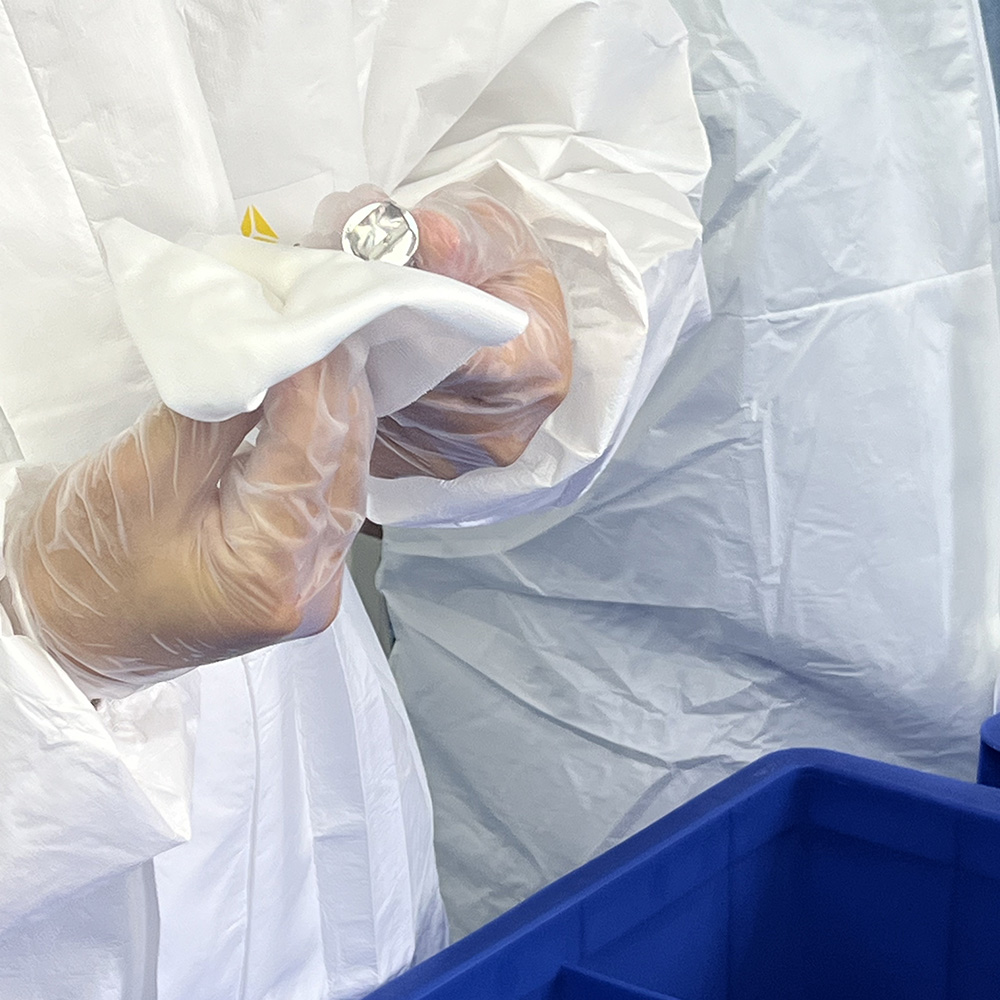
The manufacturing environment matters just as much as the product design. You must mandate strict assembly conditions. Your oil-free ball valve must be assembled, tested, and packaged in a certified cleanroom. Industry standards typically require ISO Class 4 or Class 10 environments. Assembly technicians must wear appropriate cleanroom garments. Strict gowning protocols prevent shedding biological or fabric particulates onto the open valve components.
Packaging protocols remain equally rigorous. A pristine valve becomes completely useless if contaminated during shipping. Specify double-bagging for all individual units. The inner bag should utilize high-grade anti-static materials. Furthermore, the packaging must undergo nitrogen purging before final sealing. This maintains a dry, inert atmosphere around the equipment. It preserves internal integrity from the factory floor directly to your facility.
Modern fabrication facilities also prioritize stringent environmental safety. You should reference industry-standard evaluation lenses for fugitive emissions. Standards like API 624 and ISO 15848 dictate leakage limits. They measure how much trace gas escapes into the atmosphere over the product lifecycle. Demanding compliance ensures long-term environmental safety. This becomes absolutely critical in hazardous, toxic, or highly flammable gas applications.
ISO Class 4 Assembly: Filters airborne particles down to 0.1 microns.
Nitrogen Purging: Eliminates residual moisture before shipping.
Anti-Static Bags: Prevents electrostatic attraction of ambient dust.
Procuring high-purity components requires incredibly strict vendor validation. Never accept standard hydrostatic testing for these critical applications. Hydrostatic tests use liquid water. Water introduces catastrophic moisture contamination into microscopic metal pores. Instead, require explicit proof of Helium leak testing. You must review documented data for both inboard and outboard leak rates. This guarantees a molecularly tight, vacuum-ready seal.
Implement stringent quality control audits immediately. Establish clear, objective criteria for auditing the manufacturer’s internal degreasing processes. They should utilize multi-stage deionized (DI) water rinsing. Ultrasonic cleaning remains mandatory. Vendors must use specialized, semiconductor-grade cleaning agents. If a vendor cannot provide standard operating procedures (SOPs) detailing these exact cleaning stages, reject them.
Use a structured shortlisting logic when evaluating various supplier proposals. Do not simply pick the lowest initial bidder. Baseline unit costs pale in comparison to expensive fab downtime.
Evaluation Criteria | Standard Industrial Vendor | Qualified High-Purity Vendor |
|---|---|---|
Testing Provided | Hydrostatic (Water / Air) | Helium Leak Testing (Mass Spectrometer) |
Assembly Environment | Standard Open Factory Floor | Certified ISO Class 4 Cleanroom |
Cleaning Process | Chemical solvent wipe | Ultrasonic bath + DI water rinse |
Support Structure | Basic parts replacement | Dedicated application engineering support |
Prioritize vendors offering robust engineering support upfront. Verifiable certifications and strong warranty structures matter deeply. A qualified supplier acts as a technical partner, not just a parts distributor. This structured approach mitigates your procurement risk effectively. It ensures long-term operational success.
Specifying a true oil-free valve requires exact science and rigorous risk management.
Always verify MTRs, cleanroom assembly logs, and Helium leak test results before acceptance.
Seat material selection must perfectly align with your target temperature and pressure limits.
Consult with the manufacturer’s engineering team to cross-reference line pressure, gas type, and flow rates (Cv values).
Take decisive action today to protect your high-purity systems. Download a standardized vendor capability questionnaire to audit your current suppliers immediately. You can also contact a specialized application engineer to schedule a comprehensive review of your existing fluid control architecture. Do not leave your yield rates to chance.
A: Oxygen-cleaned valves undergo degreasing to prevent combustion in oxygen-rich environments. They focus strictly on removing gross hydrocarbons to eliminate fire hazards. Semiconductor-grade valves face much stricter stringency limits. They demand extremely tight particulate allowable limits and near-zero moisture retention. They also mandate assembly inside ISO-certified cleanrooms to prevent microscopic, yield-killing contamination.
A: Hydrostatic testing uses water. Water introduces severe moisture contamination that is nearly impossible to purge completely from microscopic metal crevices. Helium leak testing uses a dry, inert gas. Because the helium molecule is incredibly small, it accurately detects microscopic leak paths that larger liquid molecules miss.
A: No. While both maintain high cleanliness, their structural focuses differ. Sanitary valves utilize Tri-Clamp fittings and cavity fillers to eliminate biological dead legs in pharmaceutical liquid lines. UHP gas valves use specialized face-seal fittings. They prioritize internal electropolishing to handle toxic, high-pressure semiconductor gases without trace micro-leakage.
A: Electropolishing significantly extends valve lifespan in corrosive environments. The electrochemical process strips away microscopic surface peaks and iron anomalies. This creates a highly uniform, chromium-rich passive layer. This specialized barrier strongly resists chemical attack, reduces particulate friction, and prevents long-term oxidative degradation of the internal metal.
