


Views: 0 Author: Site Editor Publish Time: 2026-05-12 Origin: Site


The industrial landscape is rapidly shifting. Plant operators are aggressively transitioning from traditional, bulky "two-valves-and-a-spool" isolation setups to modern, integrated systems. This evolution drives critical business and operational outcomes. A streamlined DBB ball valve reduces footprint and installation weight, which proves crucial for offshore platforms and dense petrochemical facilities. It also minimizes fugitive emission leak paths while accelerating safe isolation times.
However, selecting the right equipment involves more than just swapping out old hardware. You must navigate varying safety standards, complex seating mechanisms, and rigorous environmental compliance metrics. A poorly specified isolation setup introduces hidden vulnerabilities into your pipeline system. This guide provides a definitive framework for evaluating and specifying the correct DBB architecture. We will help you base your engineering decisions on fluid dynamics, pressure ratings, and stringent safety compliance. Read on to master the nuances of isolation valve selection.
Standard Discrepancies: Clarifies the critical engineering distinction between API 6D and OSHA definitions of "Double Block and Bleed" to prevent critical specification errors.
Sealing Architecture: Outlines when to specify SPE (Single Piston Effect) vs. DPE (Double Piston Effect) seats, and the necessity of cavity pressure relief.
Structural Integrity: Compares Monoflange (single-piece forged) versus Modular (three-piece) designs for high-risk isolation.
Risk Mitigation: Identifies primary failure modes, including abrasive internal leakage and latent operational failures.
Engineers frequently fall into a dangerous terminology trap when specifying isolation equipment. The industry uses the term "Double Block and Bleed" loosely, but official governing bodies define it very differently. Understanding this standard discrepancy is your first defense against compliance failures.
The American Petroleum Institute (API) provides a highly specific mechanical definition in API 6D. API defines a DBB as a single valve possessing two seating surfaces. These seats seal against pressure from both ends of the valve. The design must also feature a means of venting the central cavity between those seats. In practice, an API 6D DBB valve often relies on self-relieving seats to manage internal cavity pressure. It achieves double blocking through a single obturator (like a single ball) equipped with two separate seal rings.
The Occupational Safety and Health Administration (OSHA) takes a stricter, human-centric safety approach. OSHA ignores internal valve mechanics and focuses on absolute physical barriers. They mandate a strict "Three-Point Isolation System" for high-risk maintenance. This system requires two distinct, physical blocking valves separated by a centralized bleed valve. To OSHA, "double block" literally means two independent valve bodies or two separate balls placed in sequence.
This definition gap creates massive evaluation impacts. A standard trunnion-mounted single-ball valve may easily pass API 6D requirements. However, it will likely fail an OSHA compliance audit for critical human-entry isolation. If operators need to enter a confined vessel downstream, a single-ball DBB does not offer the physical redundancy OSHA demands. To pass such an audit, you must explicitly configure your setup as a dual-ball assembly, either in a modular or monoflange housing. Always verify which standard dictates your specific project safety matrix before procuring hardware.
Fluid dynamics and pressure profiles dictate your valve seat selection. You must choose the right sealing architecture to manage cavity pressure safely and maintain a reliable seal over time.
Why do engineers consider the fixed-ball (trunnion) design the standard for isolation? Floating designs rely on line pressure to push the ball into the downstream seat. They struggle to provide reliable bi-directional cavity isolation because the ball moves freely. A trunnion design anchors the ball at the top and bottom. The line pressure pushes the seats against the fixed ball instead. This mechanical stability makes trunnion models ideal for bi-directional sealing and robust cavity isolation.
A true API 6D DBB configuration utilizes two Single Piston Effect (SPE) seats. Pressure from the pipeline pushes the seat firmly against the ball. However, if liquid trapped inside the central cavity heats up, it expands. This expansion creates dangerous overpressure. Because SPE seats are unidirectional, cavity overpressure naturally pushes the seats away from the ball. The cavity safely and automatically self-relieves this excess pressure back into the main line. You do not require an external relief valve.
DIB configurations offer higher redundancy but introduce different pressure management challenges.
DIB-1 (Both seats DPE): Double Piston Effect (DPE) seats provide bi-directional sealing. Line pressure pushes them against the ball, and cavity pressure also pushes them against the ball. They deliver the highest level of hard isolation. However, they are highly susceptible to dangerous cavity over-pressurization caused by liquid thermal expansion. Because neither seat will vent naturally, DIB-1 configurations require an external safety relief valve piped from the cavity.
DIB-2 (One DPE, One SPE): This hybrid design blends safety and simplicity. The DPE seat physically isolates the downstream human-working area regardless of pressure direction. Meanwhile, the SPE seat acts as a built-in relief mechanism venting back to the upstream line. It is highly reliable but requires strict adherence to installation flow direction. If you install it backward, the valve loses its self-relieving capability.
Configuration | Seat Types | Self-Relieving? | External Relief Valve Needed? |
|---|---|---|---|
API DBB | Two SPE Seats | Yes (Bi-directional) | No |
API DIB-1 | Two DPE Seats | No | Yes (Mandatory) |
API DIB-2 | One DPE, One SPE | Yes (Unidirectional) | No (If installed correctly) |
Your plant layout and maintenance philosophy heavily influence the physical form factor of the valve. The industry broadly divides high-integrity isolation units into single-piece and three-piece constructions.
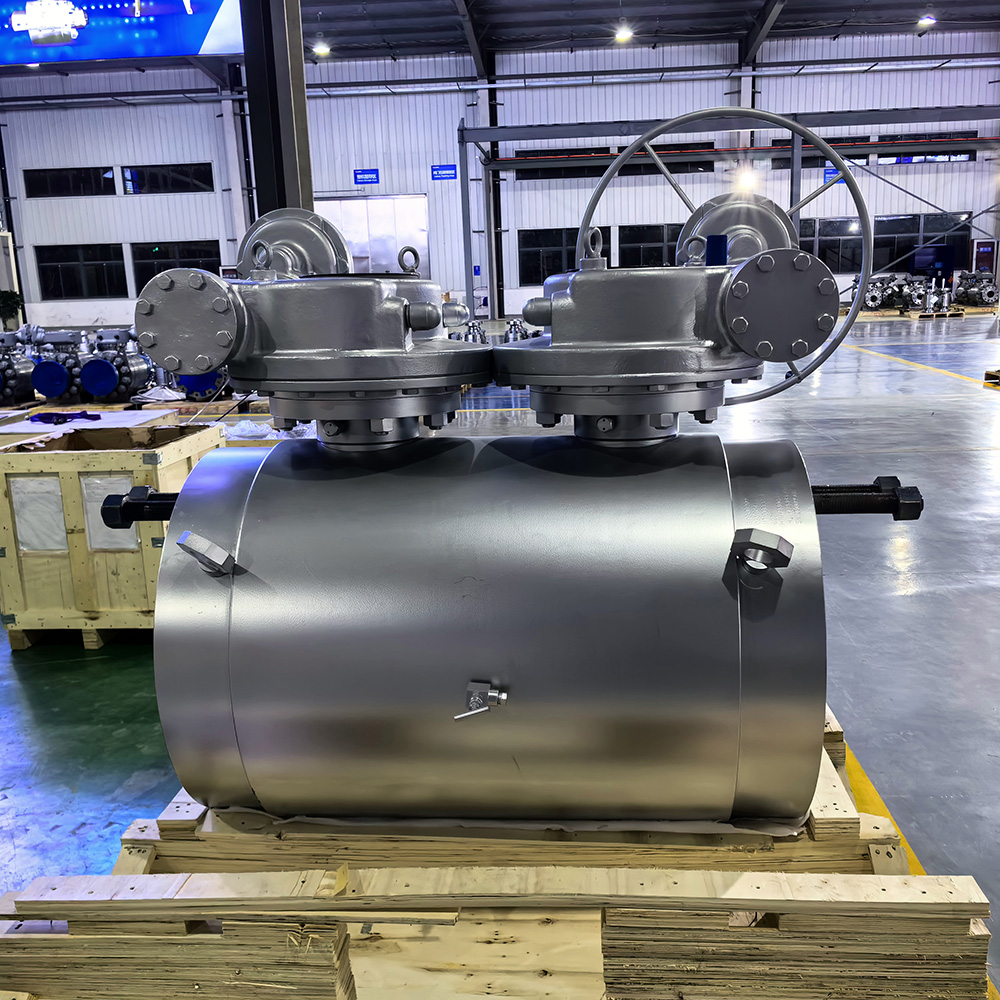
Manufacturers forge Monoflange assemblies from a single, solid block of steel. They machine the dual-ball or ball-needle-ball arrangement directly into this unified body.
Pros: A single-piece body eliminates bolted joints. This severely reduces fugitive emission paths. They offer incredible structural rigidity, making them ideal for space-constrained offshore platforms and toxic petrochemical applications where leaks are unacceptable.
Cons: Maintenance is challenging. You cannot perform localized online repair if a single seat fails. You must remove the entire assembly from the pipeline to service it.
Modular DBB assemblies use flanged or bolted construction to connect separate valve sections into one compact unit.
Pros: Modular builds allow engineers to mix valve types within one assembly. You might specify a Gate-Needle-Ball layout. They also permit maintenance crews to drop the center section for inline repair without disturbing the main pipe flanges.
Cons: They carry increased weight and require a larger operational footprint. More importantly, multiple gasket connections create a higher baseline risk for environmental leaks.
Cartridge-style variants feature extremely compact, plug-in designs. You should reserve these primarily for chemical injection points and instrument root isolation. They lack the robust flow characteristics required for primary process line blocking.
When handling explosive gases or toxic liquids, a standard commercial valve will fail catastrophically. A purpose-built petrochemical ball valve requires a specific set of non-negotiable safety certifications and mechanical guarantees.
Environmental regulations continually tighten. You must assess packing technologies rigorously. Modern valves employ a combination of Graphite and FKM (fluoroelastomer) seals in the stem area. They must pass stringent ISO 15848-1 or TA-Luft standards. Passing these tests ensures ESG and environmental compliance, proving the valve releases practically zero toxic vapors into the atmosphere.
Refineries operate under the constant threat of fire. Soft seats (like PTFE) will melt during a sustained blaze. Fire-safe certified valves feature a mechanical transition mechanism. When the soft seal burns out, spring load and line pressure physically push a secondary metal-to-metal seal into place. This prevents the valve from dumping highly flammable media into the fire.
High-velocity gas lines create heavy friction, generating dangerous static electricity. Anti-static devices (small spring-loaded balls in the stem) ground the internal components to the valve body, preventing explosive sparks. Additionally, anti-blowout stems feature an internal shoulder. Even if the packing gland fails completely under extreme pressure, the stem cannot physically eject from the valve body and injure an operator.
For large process lines, typically NPS 2 and above, emergency sealant injection ports are vital. If debris scores a seat during operation, you cannot easily shut down the whole plant to replace it. Injection ports allow maintenance crews to pump heavy sealant directly into the seat ring area. This temporarily mitigates seat damage and maintains production isolation until the next planned facility shutdown.
Even the most advanced hardware will fail if applied incorrectly. Understanding how and why isolation systems fail allows you to proactively mitigate those risks during the design phase.
Industry data shows a properly specified DBB valve maintains an isolation failure rate of approximately 10⁻³ to 10⁻⁴. Mechanical failures are rarely random. When a valve fails, investigators usually trace the root cause back to an application mismatch rather than a manufacturing defect.
Particulates like sand, pipe scale, or rust quickly destroy soft sealing materials like PTFE or PEEK. Once scored, the seat allows media to pass, ruining the isolation.
Analyze the Media: Check for suspended solids or expected pipeline debris.
Specify Metal Seats: If particulates exist, mandate Tungsten Carbide or Stellite metal-seated configurations for dirty service.
Increase Torque Margins: Ensure actuators can handle the higher friction of metal-to-metal contact.
Operators sometimes neglect to monitor the centralized bleed port. This operational risk creates dangerous latent failures. If the bleed remains unchecked, a primary upstream seal leak goes completely undetected. The cavity fills with pressure. The system degrades from "double" isolation into single isolation without operators ever knowing. Strict operational procedures must enforce periodic bleed monitoring.
Thermal lock poses a severe physical danger. If you trap liquid in the cavity of a DIB-1 setup without proper cavity relief mechanisms, ambient sun or process heat will cause the liquid to expand. Because liquids are incompressible, this thermal expansion drives internal pressure up exponentially, leading to catastrophic valve body rupture. Always verify external relief pathways for DIB-1 assemblies.
Procurement errors cost time and compromise safety. Use this structured checklist when specifying a high pressure DBB ball valve to ensure every engineering parameter aligns with your site requirements.
Specification Category | Key Evaluation Points | Common Engineering Options |
|---|---|---|
Process Parameters | Determine operating extremes. | Pressure Class (ASME 150 to 2500), Media State (gas, liquid, multi-phase). |
Material Selection | Match alloy to corrosion risks. | Carbon Steel, Duplex, Inconel. NACE MR0175 compliance for sour gas (H2S). |
Bore Requirements | Evaluate pipeline clearing needs. | Full bore (necessary for pigging operations) vs. Reduced bore (cost optimization). |
Actuation & Speed | Define required response times. | Manual gear operators vs. automated Emergency Shutdown (ESD) actuators. |
Specifying a DBB isolation unit is not simply about replacing three old valves with one new one; it is about adopting a unified safety system. These advanced configurations protect personnel, prevent environmental disasters, and streamline plant operations. The upfront investment in a forged DIB-2 or Monoflange provides significant operational returns. These modern designs drastically reduce installation weight, minimize your maintenance footprint, and lower the risk of fugitive emission penalties.
Do not finalize your pipeline specifications in isolation. As a next-step action, we strongly encourage engineers to consult with technical specialists. Request computational fluid dynamics (CFD) sizing to confirm flow rates and ask for specific General Arrangement (GA) drawings to ensure seamless integration into your existing pipeline layout. Precision in the planning phase guarantees reliable isolation for decades to come.
A: A unified DBB valve significantly reduces space and installation weight. It eliminates intermediate flange connections, which cuts down potential fugitive emission leak paths. Furthermore, operating a single integrated unit allows operators to achieve safe isolation times much faster during emergencies.
A: OSHA generally requires a rigorous dual-valve assembly—meaning two physical block valves and one central bleed. Therefore, a standard API 6D single-ball DBB may not suffice for critical human-entry isolation. You typically need a twin-ball modular or monoflange unit to pass OSHA audits.
A: You should select DIB for highly critical safety applications requiring bi-directional sealing redundancy. DIB provides hard isolation regardless of upstream pressure loss. However, you must accept the trade-off of needing external cavity relief piping for DIB-1 designs to prevent thermal lock.
A: Yes, but standard soft seals will fail quickly. If your media contains sand or scale, you must explicitly specify metal-to-metal seating. Utilizing hard-faced balls and Tungsten Carbide seats prevents abrasive scoring and maintains a reliable seal in dirty service.
